Most content teams optimize the writing. The teams winning in search and AI optimize the signals underneath it. This post explains the invisible layer that determines whether your content gets found and what one content refresh can actually do.

By Josep M Felip
You’ve written something great. The research is solid, the structure is clear, and your voice shines through. But then, your content just sits there. A few views, maybe a handful of clicks if you’re lucky, and it never climbs past the lower pages of search results. Meanwhile, a less detailed piece from a competitor ranks way higher.
Why does this happen?
It’s not about your writing. It’s about the hidden signals your content sends to search engines and AI platforms, signals most writers don’t even know exist. We’ll explore this idea in depth, and you’ll see how Alison Jeffery, a UK aesthetics practitioner, boosted their page clicks by nearly 150% by addressing these invisible signals. Their example offers a clear path forward.
Search engines don’t just scan your words. They build a map of concepts, ideas, and how those ideas connect. This map helps them decide where your content fits, what questions it answers, and whether it’s trustworthy.
Most writers focus on the surface level: keywords, topic relevance, and structure. Yes, these are important, but they’re only part of the story.
The deeper layer is semantic. It’s about showing real knowledge by connecting the right concepts in meaningful ways. For example, if you’re writing about electric vehicles, it’s not enough to just mention them, or just listing the features. You need to explain how battery technology, charging infrastructure, driving range, and environmental impact all relate, connect concepts (entities), just like an expert would.
This is what semantic structure means in practice. It’s how your content demonstrates understanding.
See exactly what AI platforms see when they evaluate your pages. Check your AI Readiness score before your next publish

Alison Jeffery, a UK Skin Clinic saw their page clicks jump from 33 to 82—a 149% increase—without adding new pages, building links, or changing her site structure. How? They refreshed the content to improve the signals underneath the writing.
Before the refresh, their page listed aftercare instructions separately: “botulinum toxin”, “heat exposure”, “arnica”.
After the update, these were connected with clear explanations that showed how they relate to each other and why they matter. This deeper connection made the content more visible across search engines and AI platforms, not just in rankings but in featured snippets and AI Overviews.
Alison’s case is a great example because it rules out other reasons for success. No new pages. No new links. No site overhaul. The only change was making the content semantically complete.
Same information. Completely different signal.
Before the refresh, their page had 33 clicks and 10,500 impressions over three months. It was showing up, but not where it counted.
Originally, the content just listed aftercare tips. After the refresh, it connected the dots the way a practitioner would: botulinum toxin, muscle relaxation, arnica, hyaluronic acid, the 4-hour upright rule, heat exposure, and specific treatment areas. These weren’t new facts, just facts given proper context and clinical reasoning.
Impressions went up before clicks did. And the 149% boost came from appearing in AI Overviews, featured snippets, and People Also Ask boxes, not just traditional rankings. Fixing these connections doesn’t just move you up the list. It widens the places where people can find you.
This also changes the usual advice about content. When things aren’t working, the instinct is to create more pages or add keywords. But that just spreads your crawl budget thin and waters down your authority. Refreshing existing content that already has some history and authority usually gives you more bang for your buck.
See how the Semantic Blueprint feature surfaces those gaps before you publish
Good writing is necessary, but it’s not the whole picture. Two articles can be equally well-written and cover the same keywords, but the one with richer, more connected information will perform better.
Search engines reward what’s called information gain, or content that adds new, specific, and connected insights rather than repeating what’s already out there.
Here are four key signals to check in your content:

Research from Ahrefs, analyzing 75,000 brands, found that brand web mentions correlate more strongly with AI Overview visibility than backlinks do. This means the signals SEO teams have optimized for over the years aren’t enough for AI discoverability. Whether you’re an SEO specialist, content writer, or agency, this gap in the signal layer is something most workflows don’t yet address.
When working with content teams across small and mid-sized businesses, one thing becomes clear: most focus heavily on backlinks and keywords. That means they’re optimizing for the retrieval stage of search, getting their content noticed and considered, that is.
But modern search, especially AI-powered discovery, has a second stage: selection.
Backlinks help with retrieval, no doubt. But what really influences selection are the connections between concepts in your content, your entity relationships. Many teams miss this, which is why pages with strong domain authority can still lose out to lower-authority sites that have richer semantic signals.
The bottleneck isn’t getting your content considered anymore. It’s getting it selected.
That doesn’t mean backlinks don’t matter, they do. A strong backlink profile gets you into the running. But strong entity connections and rich information density decide whether you get cited, featured, or shown as the answer. The teams winning now optimize for both and check the signal layer before they publish, not after.
E-E-A-T signals (Experience, Expertise, Authoritativeness, and Trustworthiness) work exactly at this level. They’re not just about your site’s reputation but how your content explains why, not just what. Saying “Avoid heat” is a list item. Saying “Avoid heat because elevated temperatures can cause the toxin to migrate before it binds” is expert content. That difference, or causal reasoning versus instruction, is what separates listed entities from connected entities. And AI systems can detect it.
Structured data based on entity analysis then maps these connections clearly to the knowledge graph, making them easy to understand for both search engines and AI platforms.
Fixing your entity relationships today doesn’t mean the job is done. Research from Ahrefs looked at 43,000 keywords and found that AI Overviews refresh their citations every 2.15 days on average. That means citations change often. Entities shift. Getting cited once doesn’t guarantee you’ll stay cited.
In fact, based on that same research, 45.5% of citations change when AI Overviews update. More than half of the pages cited at any moment won’t be there two days later.
That’s why semantic structure isn’t a one-time fix. It’s the foundation you build on continuously. Content that is structurally complete, rich in entities, and AI-ready doesn’t just earn citations once. It stays in the running as platforms refresh. That’s a very different outcome from content that gets a single citation and then fades away.
If you’re wondering what this looks like in practice—how to optimize for AI search without losing the voice that makes your writing valuable—that’s exactly what we'll cover in this post.
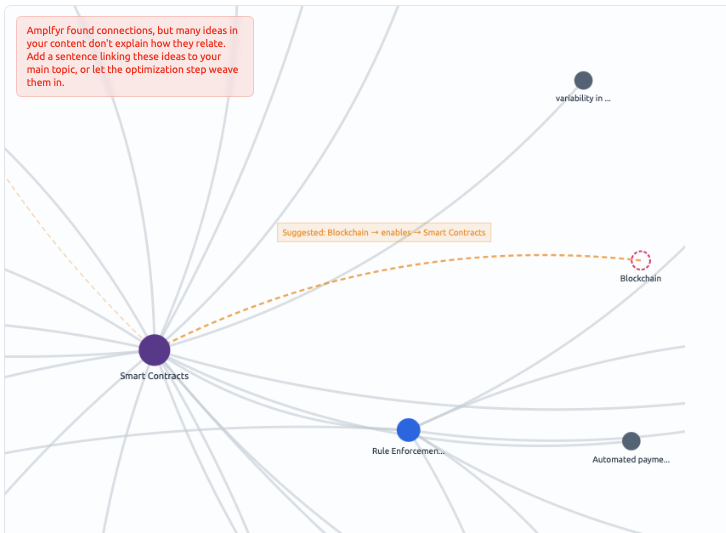
The answer starts with checking the signals before you publish. Amplfyr’s Semantic Blueprint maps your content as an interactive knowledge graph, showing which entities are connected and which are isolated. In Alison Jeffery’s case, the original content listed botulinum toxin, heat exposure, and arnica as separate instructions. The Semantic Blueprint revealed these were orphan entities. They’re mentioned but not connected to each other or to the clinical reasoning that makes them meaningful. That’s what the refresh fixed.
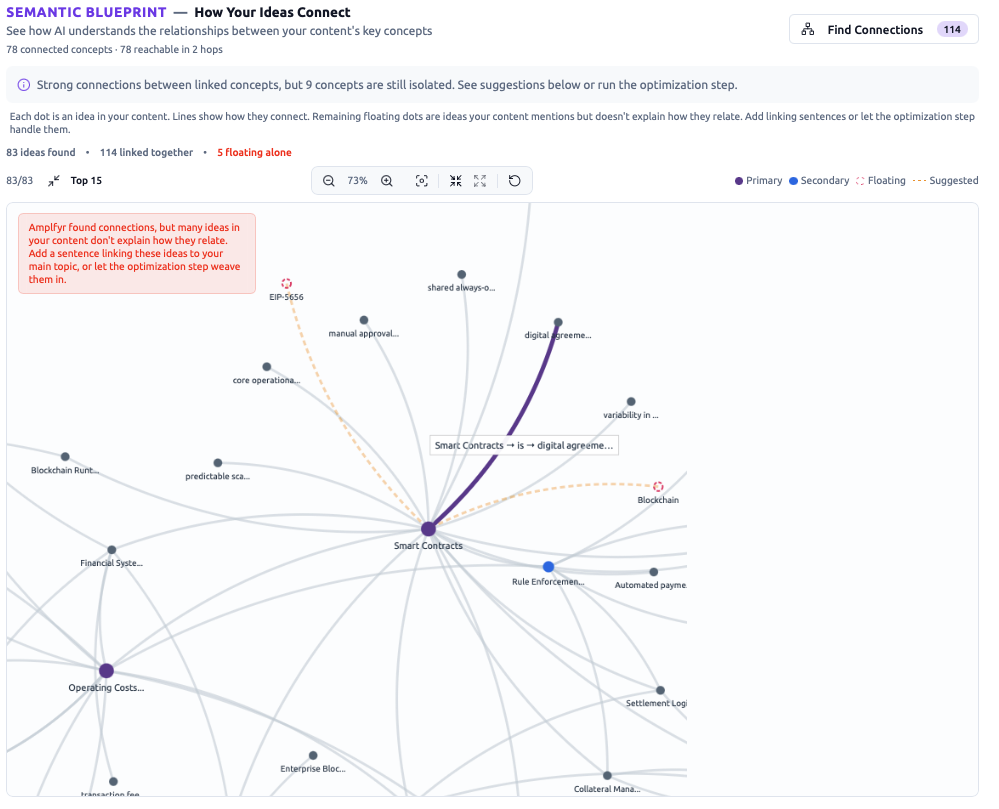
The AI Readiness score then shows whether your content is structured so AI systems can chunk, parse, and cite it. A piece can rank on page one in traditional search but still score poorly on AI Readiness. The structural requirements truly differ, and most content tools don’t measure both.

The biggest missed opportunity is timing. Most writers finish their draft, send it for review, and publish without checking these deeper signals. Months later, when the content underperforms, it’s too late to fix without a major rewrite.
What you need is a pre-publish signal check, which shows how your content looks to search engines and AI before it goes live. This isn’t about keyword density or readability scores. It’s about mapping which concepts you cover, how they connect, and what’s missing compared to top-ranking content.
Tools like Amplfyr’s Semantic Blueprint and Information Gain Analysis can help you do this. They show you where your content’s connections are weak or missing, so you can fix them early.

If you have content that’s not performing as expected, ask yourself:
If your answer to any of these is no, the problem isn’t your writing style. It’s the invisible signal layer underneath, and it’s something you can improve.
When content underperforms, the instinct is often to create more pages or add keywords. But this can spread your crawl budget thin and dilute your topical authority.
Refreshing existing content that already has indexing history and established entity associations is usually a better investment. Alison Jeffery’s case proves this: one refresh, no new pages or links, and a 149% increase in clicks.
Your voice is already strong. What’s missing is the smart signal layer that tells search engines and AI your content is expert-level. Once you can see that layer, you can fix it before publishing. That’s how you turn good writing into pure visibility.
Your voice. Smart signals. Pure visibility.
Hit publish with confidence. Not hope.
It’s not about word count but how much useful info you include. A 2,000-word page that repeats ideas has low information density. Search engines and AI value rich, connected concepts. Alison Jeffery’s page saw a 149% impression increase by adding clearer reasoning, not more words.
Refreshing works better because existing pages have indexing history and crawl priority. New content with the same gaps spreads your crawl budget thin and weakens authority. Alison Jeffery’s refresh boosted clicks by 149% and queries by 159% without new pages or links.
Content that lists features without connecting them is like isolated dots. For example, a SaaS page might list “automation,” “integrations,” and “reporting” but miss explaining how automation speeds up deals and boosts revenue. Connected explanations signal expertise and help content get cited by AI.
Find entities mentioned but not connected. Add clear explanations that link them and explain why and how. Use structured data to map these connections to the knowledge graph. Tools like Amplfyr’s Semantic Blueprint highlight orphan entities so you know where to improve.


Josep M Felip is an SEO consultant and founder of Amplfyr, a platform helping brands get discovered across AI search, Google AI Overviews, and large language models.
He’s been working in digital since 2006, and as SEO full time since 2009. Originally from Badalona and now based in Brighton, Josep has worked across ecommerce, travel, agency, and in-house corporate roles.
He’s a mentor, speaker at conferences including BrightonSEO and Search Barcelona, and has been judge for the UK, European, and Global Search Awards. Today, his work focuses on how content is retrieved and selected by AI systems, because in modern search you're not competing to rank, but to be chosen.