A local clinic website. One page. Three months of GSC data.

The page existed. It was written by a qualified practitioner. It covered the right topics. It just wasn't performing.
Before the refresh:
The content wasn't wrong. It was thin on signals. It answered patient questions, but it didn't connect the underlying entities the way a genuine expert would. The procedures, substances, timing rules, and physiological responses existed in isolation. Google couldn't map it against the full range of relevant searches. So the page ranked for a fraction of its potential.
Amplfyr's content refresh doesn't involve new pages, new links, or a site restructure. It works on what's already there by giving search engines the signals they need to understand, trust, and rank it.
For this page, the refresh focused on three things:
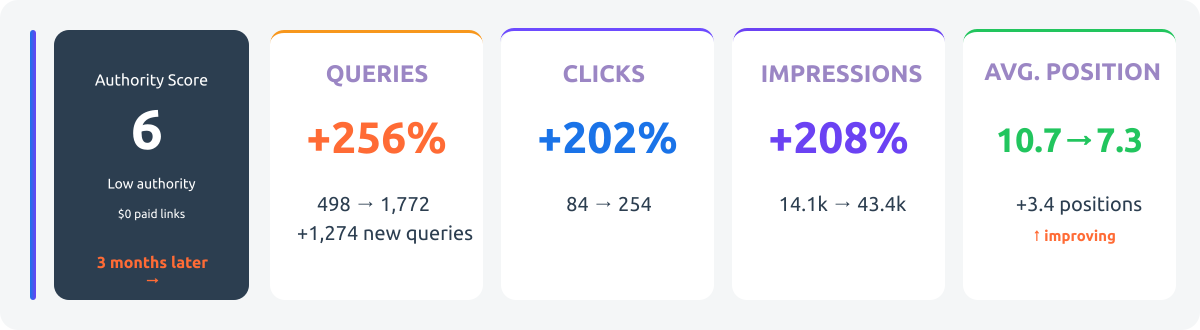
Three months after the refresh, Google Search Console told a clear story.

Query breadth
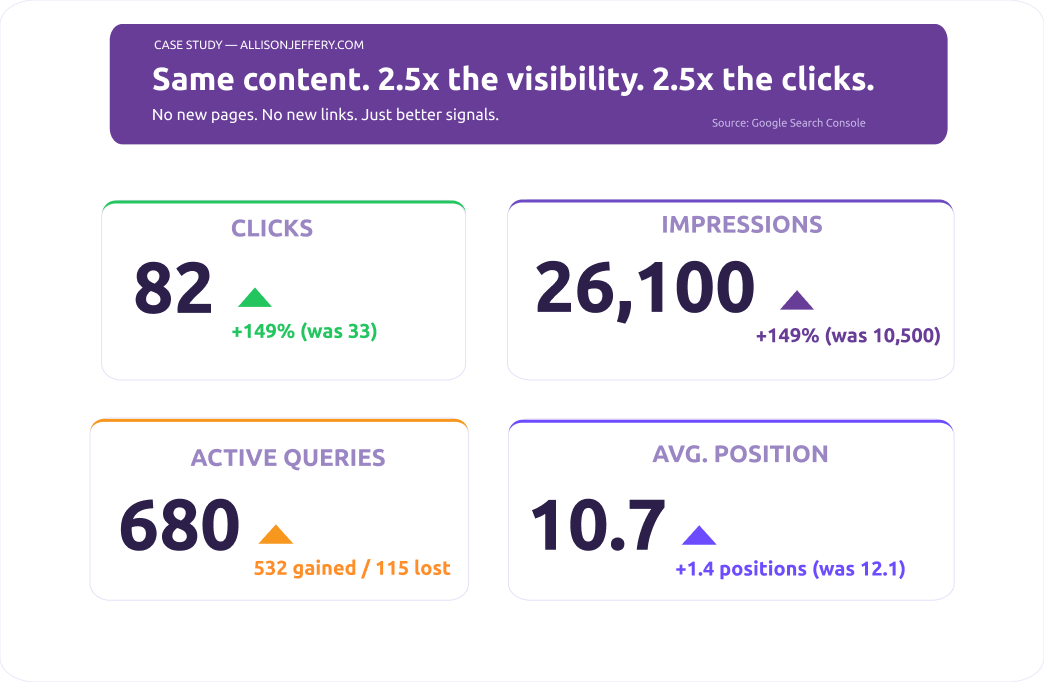
The page went from 263 active queries to 680 with 532 new queries gained and only 115 lost. It now covers 12 distinct search intent groups (collections of related searches with similar goals), including:
That breadth of coverage simply didn't exist before.
The expansion is consistent with what entity enrichment is designed to produce: when content is structured around a specific audience and their actual questions, it naturally covers more of the search space that audience occupies.
Whether the refresh is the sole cause is harder to isolate. Several factors can influence query coverage during a three-month window:
What's clear is that the direction and scale aligns with the methodology, and 532 new queries being recognized and ranked by Google in a single period isn't something that happens passively.
The 115 lost queries are worth noting too. Tightening content around the right audience and entities doesn't just add relevance; it sheds it where it was never a good fit. Losing peripheral queries—loosely related searches from the wrong audience—while gaining 532 targeted ones is the signal working as intended.

CTR stability
CTR held at 0.3% despite absorbing 532 new queries, all entering the index at low positions. New queries mathematically drag CTR down because they generate impressions without clicks while they're still ranking poorly. Holding flat against that dilution is a strong signal that established queries continued to perform well—and may have even improved to offset the drag from new rankings. In other words, the refresh didn't disturb what was working.
Position trajectory
Average position improved from 12.1 to 10.7 overall. Here's why the day-89 snapshot matters more: by that point in the tracking period, the page was ranking at position 6.2, compared to 16.8 on the same day in the previous period. Most ranking improvements show early gains that taper off. This is doing the opposite—the velocity is increasing, not slowing. The page isn't just ranking better; it's building algorithmic trust faster over time.
A note on impressions
GSC impressions include appearances in AI Overviews and featured snippets, not just standard organic results. Here's why that context matters for the 149% impression uplift: we can't isolate how much came from traditional ranking improvements versus SERP feature placements. The growth is real and consistent across every other metric, but some portions may reflect appearances in AI Overviews, featured snippets, or People Also Ask boxes. Bottom line: the page is capturing more visibility across Google's ecosystem, which builds authority and traffic potential—even if not every impression translates to a click.

You don't always need more content.
This page already existed. The growth came from making the existing content richer, more semantically complete, and more clearly expert. For most websites, existing content that's not reaching its full potential is one of the biggest untapped assets.
Entity relationships appear to drive query fan-out.
This data is correlational—based on one page, one refresh, and one comparison period. While we can’t claim causation yet, the direction and scale align with the theory. We’re continuing to monitor this as an ongoing experiment.
Impression growth precedes click growth.
The 149% increase in impressions lays the groundwork. As the average position climbs toward the top of page one for the highest-volume queries, the potential for increased clicks is substantial—and we’re already seeing early signs of that growth.
Amplfyr helps SEOs and content teams unlock the organic potential of existing content through structured entity enrichment and E-E-A-T optimisation.
Your voice. Smart signals. Pure visibility.