Most advice about AI search optimization quietly assumes you have to trade voice for visibility. This post argues the opposite and shows you what smart signal work actually looks like in practice.

By Josep M Felip
You spent hours on that piece. The argument was tight. The sentences had rhythm. The perspective belonged to you alone. Then you published it, and a flat, generic competitor article ranked above it, got cited by AI tools, and earned the clicks your work deserved. That is not a content quality problem. That is a signal problem. And the two are not the same thing.
We've seen this play out with a UK aesthetics practitioner — allisonjeffery.com — whose clinical expertise was already present in the content. What was missing was precision: named mechanisms, explicit entity relationships, experience-based claims made verifiable rather than implied. Once those signals were strengthened, total impressions grew from 10,500 to 26,100 and active queries rose from 263 to 680. No new backlinks. No domain authority change. Signal quality determined the outcome.
More on how that worked in the case study below.
Most advice about optimizing for AI search sounds like this: use clear headers, answer questions directly, keep sentences short. Reasonable. Not wrong. But not what makes an AI platform choose your content over someone else's.
The version nobody talks about is the writer who, told to "optimize for AI," strips out every flourish, every considered phrase, every sentence that sounds distinctly human — and ends up with something that passes a checklist but reads like it was produced by the tool they were trying to optimize for. This is the wrong trade-off. And it rests on a misunderstanding of how AI search actually works.
See exactly what AI platforms see when they evaluate your pages. Check your AI Readiness score before your next publish

When an AI platform generates a response, it does not pull one piece of content and summarize it. It runs a two-stage process, and most writers only optimize for the first stage.
The platform searches for content that matches the meaning of the query. This is vector-based search: it’s looking for concepts and relationships, not exact keyword matches. It looks to semantically understand it. Your content either makes it into the candidate pool or it doesn’t.
What gets you in? Naming specific things (people, methods, tools, concepts) — that's entities — and showing how they connect to each other.
A piece that says “Cold brew coffee tastes smoother than hot brew because steeping grounds in cold water for 12-24 hours extracts fewer bitter compounds like quinic acid while preserving the sweeter chlorogenic acids” gives AI something concrete to work with. A piece that says “cold brew tastes better because of how it’s made” doesn’t.
Next, the platform picks the content most likely to produce an accurate, credible answer. This is where voice and expertise matter.
Ai platforms favor content that:
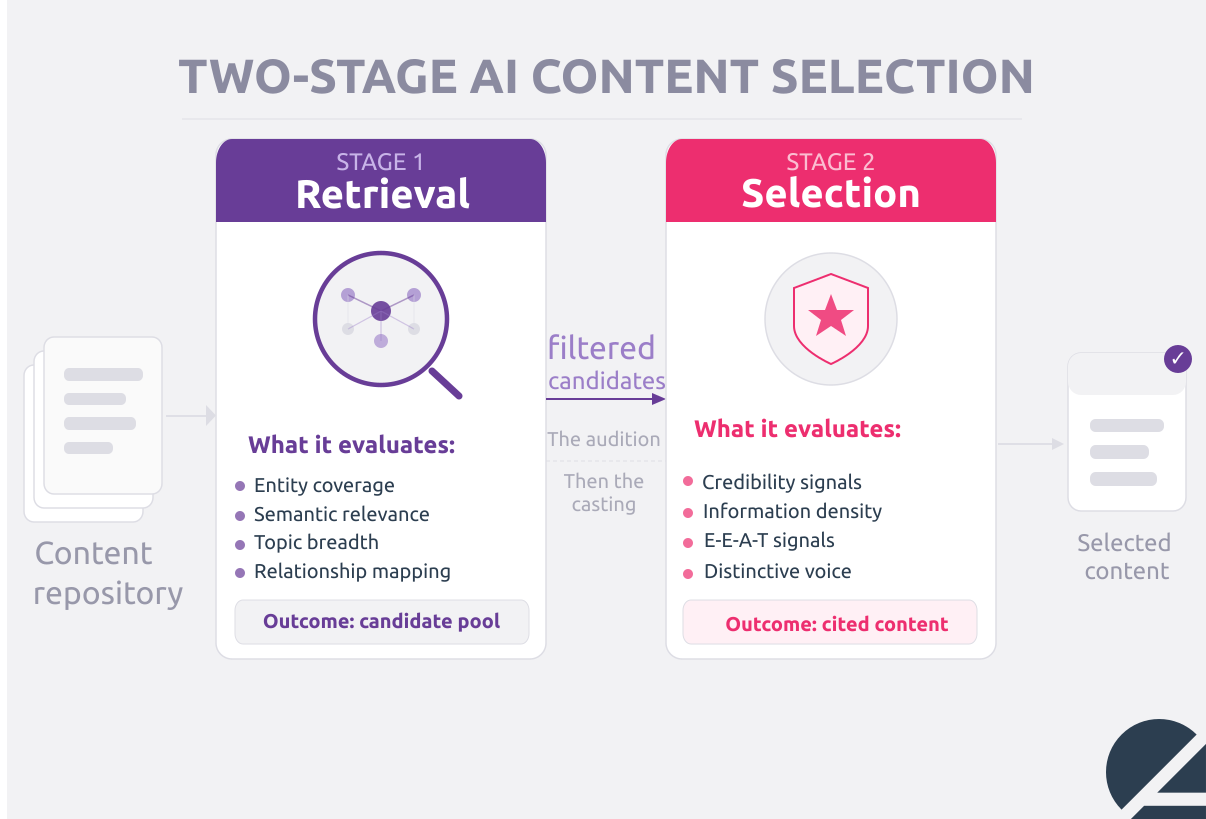
Here’s what I’ve seen most advice misses: these two stages need different things. Stage one needs concrete details and clear connections between ideas. Stage two needs credibility and the kind of specificity that comes from actually knowing your subject.
When your voice carries precision, it serves both stages at once. That’s not luck. That’s how the system works.
Think of it this way: Stage one is getting called for an audition. Stage two is getting cast. You get the audition with clear structure and specific details. You get cast when your content sounds like it knows what it’s talking about.
The common mistake is treating Stage 1 and Stage 2 as the same problem and then solving for Stage 1 at the expense of Stage 2.
You see, writers who focus only on retrieval start adding headers, compressing paragraphs, inserting FAQ sections. This approach makes the content easier to parse, good! But also easier to ignore. Nothing distinctive stands out for selection.
Every paragraph answers a question in the same neutral tone. While entity coverage improves, the authority signal disappears. The result is content that enters the candidate pool and loses the selection round because nothing in it signals that the writer truly understands the subject.
On the other hand, writers who ignore Stage 1 entirely produce beautifully crafted content that AI platforms cannot index correctly. The concepts are present, but the relationships between them are implied, felt, assumed, embedded in syntax and tone rather than made explicit.
Language models can’t extract what’s implied. Rather, they map what is stated: subject-predicate-object. (semantic triples), cause and effect, type and instance..
If those relationships live only in the subtext of a well-turned sentence, the retrieval layer can’t see them.
The fix is not to abandon one approach for the other. Your voice and your signals form different layers of the same content, and strengthening one does not require weakening the other.
Precision is not the enemy of style; imprecision is.
Enough theory and more substance. Signal optimization, done correctly, does not require a rewrite.
It requires a different kind of attention, one that works with your existing voice rather than against it.
There are four layers worth understanding.
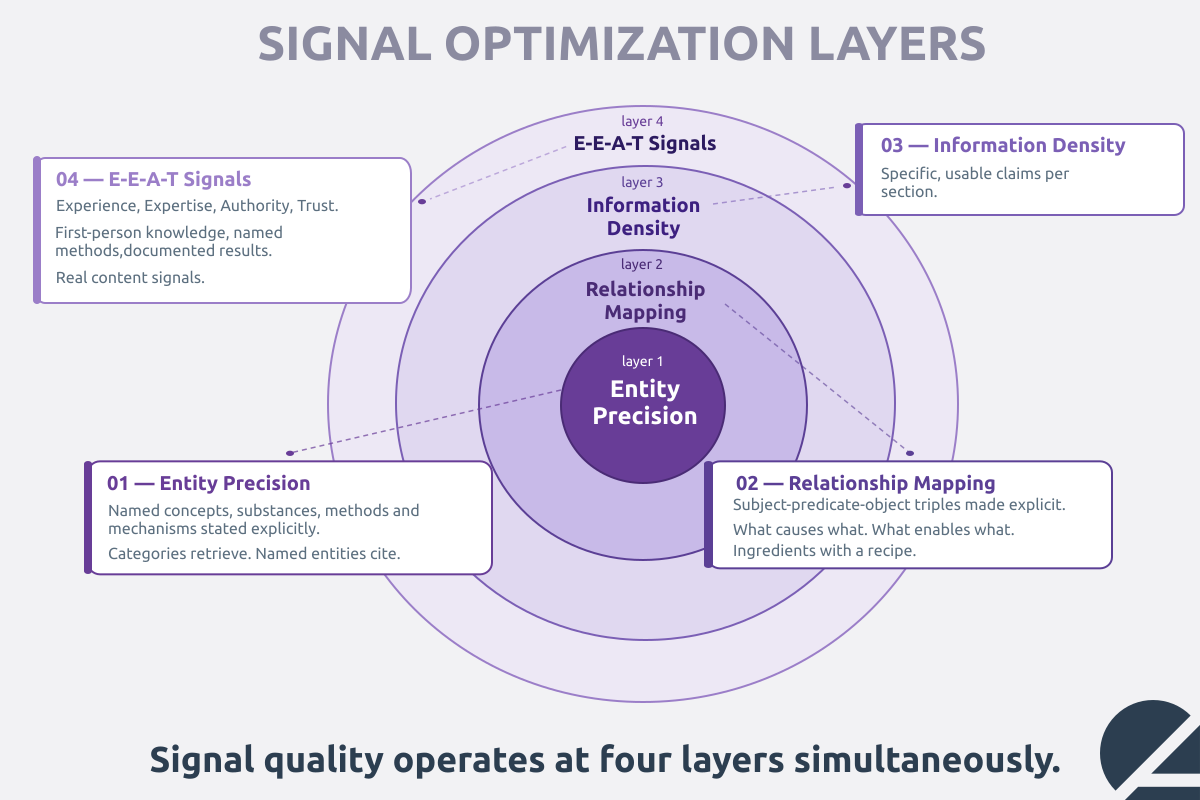
Interestingly, most optimization frameworks never seriously address voice preservation because they focus on improving signals, not protecting what makes content worth reading.
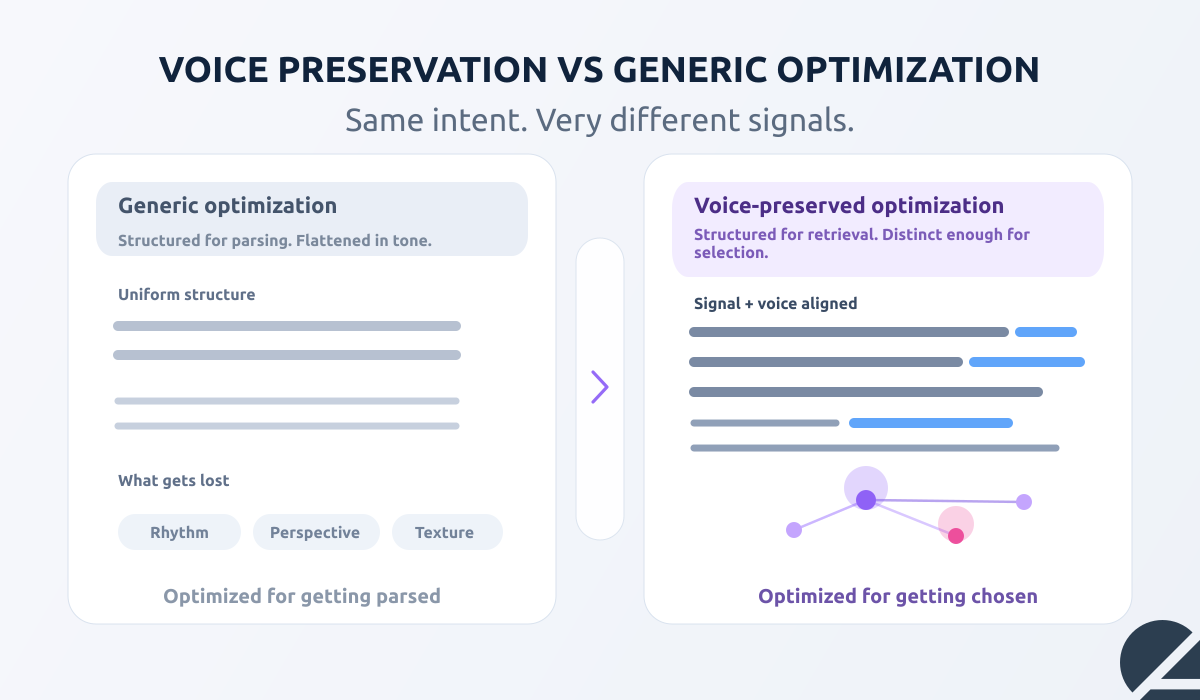
Voice preservation is not a secondary consideration. It must be active during optimization, not a corrective step afterward. When optimization prioritizes signal density without regard to voice, it introduces vocabulary that doesn't belong, flattens sentence rhythm, and replaces considered phrasing with retrieval-friendly but tonally dead constructions.
Yes, the result performs technically in the short term but erodes brand authority in the medium term.
It starts sounding like everyone else in the category. And in an environment where AI platforms are selecting for distinctive, credible, authoritative voices, sounding generic is a visibility strategy that works against itself.
In other words,voice profile extraction needs to happen before optimization begins, not after.
The vocabulary patterns, sentence structures, tonal registers, and characteristic transitions that define a writer's work must be treated as fixed parameters, not as variables to be adjusted.
Signal improvements then happen within those constraints. The content that emerges is both more retrievable and still recognizably authored.
Working with independent content writers and brand teams, I've consistently see that content holding its voice through optimization earns more sustained AI visibility than technically optimized but stripped of its authorial signature.
The model is not just selecting for entity coverage but for a coherent, distinctive perspective that signals genuine expertise. Voice is that signal made legible.
Let's consider the case of allisonjeffery.com, a UK aesthetics practitioner.
This site’s total clicks grew from 33 to 82 (+149%), and active queries rose from 263 to 680 (+159%), without stripping the site's voice to a neutral template, but by making its existing expertise more explicitly signal-rich.
The practitioner's clinical knowledge was already present. What changed was the precision of entity relationships and the degree to which experience-based claims were made verifiable rather than implied.
As a result, total impressions grew from 10,500 to 26,100 (+149%) in the same period.
Voice stayed intact and improved.
Signals strengthened.
Visibility followed.
See how the Semantic Blueprint feature surfaces those gaps before you publish
The retrieval-versus-selection framework has a specific implication for content writers and copywriters: You do not compete against generic AI-generated content at the retrieval stage. You compete at the selection stage.
At selection, your voice is a competitive advantage, not a liability!
As I explained earlier, generic content enters the candidate pool because it covers expected entities and answers common questions predictably. But it consistently loses the selection round because it doesn’t offer anything to distinguish it as a credible, authoritative source. Why?
Because the model has no reason to prefer it.
Every piece that sounds the same is equally ignorable.
Your content, if it carries genuine expertise and distinctive perspective, wins selection rounds that generic content can't.
The practical implication for your workflow is this: the pre-publish checklist in the AI era should focus on signal quality, not just structural requirements. Signal quality depends on how precisely and explicitly you express your expertise.
On another test we did, A DA-6 page optimized for semantic signal quality appeared in Google AI Overviews above DA-60+ content within 9 to 12 hours. Signal quality determined the outcome, not Domain Authority. That means the playing field is more level than ever for writers who understand how to work it.
The writers who position themselves as AI-era specialists make their human expertise machine-readable without making it machine-like.
That distinction is the whole game.
Before publishing, ask yourself these three questions: .
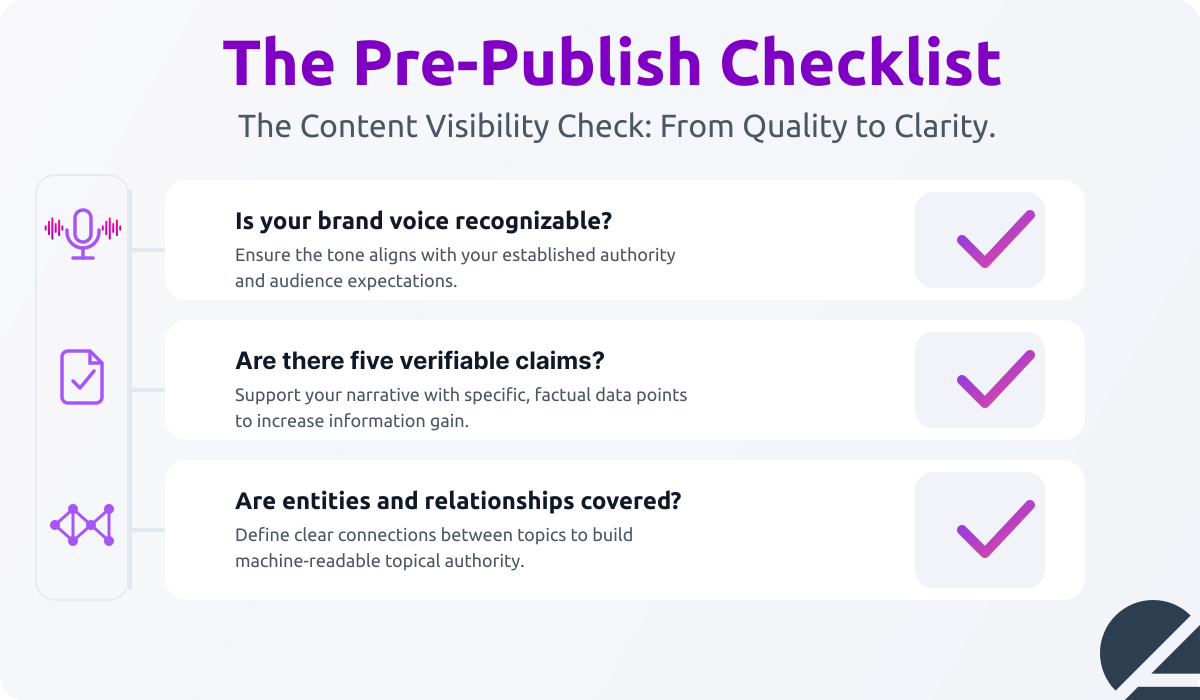
Answering yes to all three means the signals work and your voice remains intact.
That combination consistently earns visibility that compounds because cited content becomes more authoritative and more likely to be cited again.
Many people in the Search industry assume the future of content is structured, neutral, and interchangeable. That winning means writing like a well-organized FAQ: predictable entities, expected relationships, indistinct perspective that introduces ambiguity.
That assumption is wrong.
AI platforms consistently select content that is specific, credible, and authoritative.
It contains verifiable claims. It comes from someone who knows the subject at depth, and that knowledge shows in precise language, explicit relationships between concepts, and E-E-A-T signals that a neutral, generic piece simply cannot generate.
The model selects for trustworthiness, which looks a lot like expertise expressed with clarity.
I’ve seen great content ignored by algorithms because they're missing machine-readable signals:
The fix isn’t to make writing worse but to make the expertise more explicit.
SEO tools optimize keywords.
Writing tools optimize words.
AI-era tools, like Amplfyr, optimize signals while holding the voice constant.
That difference separates content that performs and content that performs while remaining worth reading.
Your voice is not the obstacle to visibility. With the right approach, it is the signal. The content that gets cited is most genuinely authoritative.
Authority, expressed with precision, comes only from a writer with real knowledge.
Your voice. Smart signals. Pure visibility.
Hit publish with confidence. Not hope.
It’s not about word count but how much useful info you include. A 2,000-word page that repeats ideas has low information density. Search engines and AI value rich, connected concepts. Alison Jeffery’s page saw a 149% impression increase by adding clearer reasoning, not more words.
Refreshing works better because existing pages have indexing history and crawl priority. New content with the same gaps spreads your crawl budget thin and weakens authority. Alison Jeffery’s refresh boosted clicks by 149% and queries by 159% without new pages or links.
Content that lists features without connecting them is like isolated dots. For example, a SaaS page might list “automation,” “integrations,” and “reporting” but miss explaining how automation speeds up deals and boosts revenue. Connected explanations signal expertise and help content get cited by AI.
Find entities mentioned but not connected. Add clear explanations that link them and explain why and how. Use structured data to map these connections to the knowledge graph. Tools like Amplfyr’s Semantic Blueprint highlight orphan entities so you know where to improve.


Josep M Felip is an SEO consultant and founder of Amplfyr, a platform helping brands get discovered across AI search, Google AI Overviews, and large language models.
He’s been working in digital since 2006, and as SEO full time since 2009. Originally from Badalona and now based in Brighton, Josep has worked across ecommerce, travel, agency, and in-house corporate roles.
He’s a mentor, speaker at conferences including BrightonSEO and Search Barcelona, and has been judge for the UK, European, and Global Search Awards. Today, his work focuses on how content is retrieved and selected by AI systems, because in modern search you're not competing to rank, but to be chosen.

