The Impossible Challenge
Imagine trying to rank for competitive lifestyle and home improvement topics when your website has:
This was the reality facing friendsocl.com, a community platform for book lovers connected to the Friends of the Chelsea Library in Alabama.
Who they were up against
The “how to build a home library on a budget” page entered a search space dominated by established lifestyle publications with massive advantages:
According to conventional SEO thinking, friendsofcl.com had no business competing in this space.
Traditional approaches would suggest:
But friendsocl.com didn’t have months or years. They needed results that could prove content quality matters more than domain metrics.
The real problem: Speed vs autority
The core challenge wasn’t just about competing, it was about proving that content built with the right signals could rank immediately, regardless of domain authority. This required a fundamentally different approach to content creation, one that prioritized:
The Amplfyr methodology
Rather than competing on authority, Amplfyr focuses on building content with the exact signals that search engines and AI systems recognize as trustworthy and complete. The platform addresses the core challenge of creating content that ranks immediately by:
The key differentiator is speed. While competitors spend weeks or months creating content through traditional processes, Amplfyr enables:
Overall site transformation
Before diving into the hero pages, the sitewide results demonstrate the power of the Amplfyr approach:
GSC query counts reflec the total unique searches the site appeared in during each period, not a point-in-tima word ranking
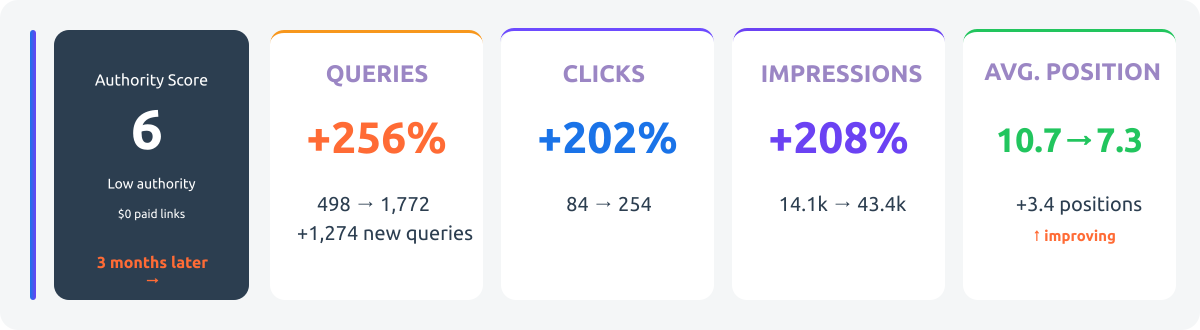
256% more queries, 202% more clicks, 208% more impressions. Average position up from 10.7 to 7.3
The query numbers frames everything else: the site went from appearing in 498 distinct searches to 1772, and additional 1274 searches it simply wasn't part of before. More than improving content, that's new search territory being claimed.
All organic. No paid traffic. No link-building campaign. No site restructure. Just new content buitl with Amplfyr, published onto a domain with authority score 6.
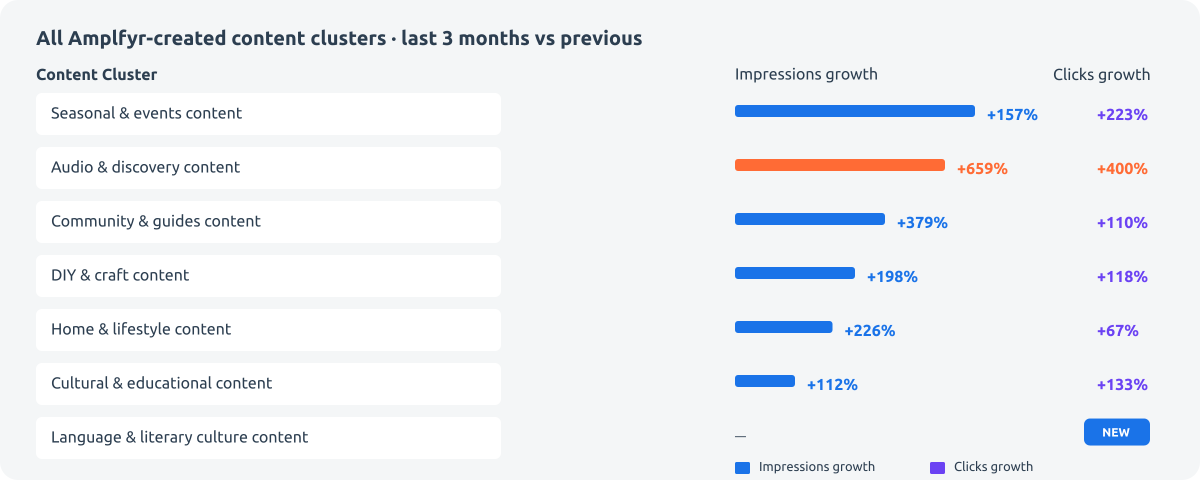
The audio & discovery cluster deserves a second look: +659% impressions, +400% clicks, from a page that barely registered in the previous period. That's not incremental growth, that's a content cluster breaking open.
Published: January 4, 2026
Competition: The Pioneer Woman, ABI Interiors UK, Facebook communities
The speed of success.The GSC data tells an unambiguous story. Before January 4, the article didn't exist — zero position data for its target queries. Then on January 4, it went live. Within 11 hours of requesting Google indexing:
This page proved that domain authority is a proxy for content quality, not a substitute for it. The authority score 6 site outranked established publications because the content was more entity-complete, more semantically structured, and more directly answering of user intent.
Published: February 9, 2026
This is the page that shows exactly what happens when entity-rich, semantically complete content publishes into a space it was built to own.
From November 4, 2025 through February 8, 2026 — the day before publication — this URL recorded zero impressions. The page didn't exist, and search engines had nothing to say about it.
Then on February 9, it published. By the end of that same day, Google had already placed it in the top 5 for its target query, 19 impressions at average position 5.1. Not after weeks of crawling and indexing delays. On the day it went live.
By day two, impressions had more than doubled to 45. By day five, the page was generating 68 impressions at position 5.9, still in the first week of its existence. From that point it never fell back to zero. It settled into a consistent daily rhythm of 44 to 69 impressions, holding an average position between 6 and 8, week after week.
Over three months, a page that didn't exist in November reached 2,265 impressions at an average position of 6.96,from a community library website in Alabama, on a domain with authority score 6.
Within 12–16 hours of publication, the literary quotes page became a cited authority across every major AI search surface simultaneously.
Google Featured Snippet (Position 0): The page claimed the featured snippet for "how literary quotes become pop culture catchphrases", outranking Reddit (r/books, 2.3K+ comments), ResearchGate, and Cornell Chronicle. Google displayed the article's opening line as the definitive answer above all other results.
Google AI Overview: cited across 4 separate queries A single page, pulled as a source by Google's AI Overview for four distinct searches:
Each is a different user intent. The same page answered all four well enough for Google's AI to cite it as a source — because the content covered the topic with the depth that AI retrieval systems require.
Google AI Mode: #1 cited source. The page appeared as the primary recommended source in Google's AI Mode — Google's newest, most AI-native search interface — for the core query.
ChatGPT: cited twice in a single response. ChatGPT cited the Friends of the Chelsea Library article as a primary source alongside arXiv, Springer, and Psychology Today. It was cited a second time in the same response for a separate specific claim, labelled "Friends of the Chelsea Library +1."
arXiv. Springer. Psychology Today. Authority score 6.
Google Images: 6 images indexed and ranking All six images from the article were indexed and appearing in Google Images results within 24 hours, creating an additional visual discovery surface.
Complete AI and search visibility within 12–24 hours of a single publish.

Screenshot of the AIO on the 11 Feb 2026, showing FOCL results on first place, two days after publishing the blog post about Pop Culture catchphrases.
Entity Depth That Reads Like Genuine Expertise
The literary quotes article connected the entities that a genuine expert in cultural linguistics would connect: cognitive heuristics, the Matthew Effect, prestige bias, "quote magnets," contextual flexibility, specific named phrases (Catch-22, "go down the rabbit hole"), social media amplification mechanisms, misattribution psychology. These concepts were named correctly and their relationships explained clearly.
Google's knowledge graph and AI retrieval systems identify content that demonstrates real understanding of a subject: conceptual map completeness, not keyword density. When content maps entity relationships the way an expert would, it signals trustworthiness independently of domain metrics.
That's why a DA 6 site appears alongside Springer and arXiv in a ChatGPT source panel.
Semantic Breadth Built for AI Retrieval
AI Overviews and ChatGPT don't retrieve pages, they retrieve answers. The literary quotes page was structured to address the full landscape of related questions: why quotes persist, what makes them memorable, how they spread, why misattributions happen, what role the internet plays. Each sub-topic became a separate AI retrieval surface. One page. Four AI Overview citations. Because the content covered the topic completely.
Speed as a Competitive Advantage
19 impressions at position 5.1 on the day of publication means Google crawled the page and decided it belonged in the top 5 immediately. While competitors spend weeks creating content through traditional processes, Amplfyr enables same-day content creation with full entity mapping and AI-ready formatting built in. By the time competitors notice a ranking opportunity, Amplfyr users have already claimed it.
This isn't a story about grinding up the rankings over months. It's proof that when content is built with the right signals from the start, even a domain authority 6 site can claim position zero within hours and compete with the biggest names in search results.
The David vs. Goliath story isn't just inspiring, it's replicable. Amplfyr makes it possible for any site, regardless of authority or budget, to compete where content quality and speed matter more than backlinks and domain age.
See how Amplfyr builds the right signals into your content from day one.

